Having a positive attitude is important. When you have a positive mindset, you approach life differently. You will see beauty, opportunity and optimism in each “struggle” or “challenge.” Instead of seeing the glass half empty, you will look at the glass half full. When watching the news or reading the papers of current events in Kathmandu and around Nepal, you might not exactly see inspiring stories or success stories on a frequent basis. It’s tough to be positive when things around you are not going well. Thus, I see having a positive attitude as not only a coping mechanism but a way to keep moving forward. I have met countless enthusiastic and positive minded people in Kathmandu from entrepreneurs, artists, writers to teachers, students and social workers. Each of them are passionate and equally positive about life and you can feel their positive energy when you have a conversation with them. These individuals are making an impact in many sectors of the country and are an inspiration to the new generation. I get inspired by just watching them.
Proactive
A lot of times, we think that “good things come to those who wait.” Well, great things come to those who go for it. I feel like in Kathmandu, a lot of people are just waiting on the sideline hoping that someone will take charge, solve their problems or do the tough work for them. Very few people want to get into the field and join the action. You won’t change much of anything if you just stand on the sideline and talk. If you get frustrated by what you see in Kathmandu or throughout the country, the only real solution is doing what you can to solve the problem. Let’s not wait for the government to do each and everything and not contribute anything from our side. Are you not happy with how the school system works or the quality of teaching? Well, start teaching. Are you not satisfied with how the political system works? Well, start one or join one that fits your values and ideas. Are you not excited about the work that you do on a daily basis? Well, start doing something that you love and live happily. It irks me to see talent get wasted when it could have been used for doing something great. Be proactive and get out there to do at least one thing to create the change that you want to see. You will always feel a sense of accomplishment and your life will be more meaningful if you take that step. The present and the future belongs to those who are proactive.
Patience
While being proactive is a virtue, I also believe that patience goes a long way. Having grown up in the instant gratification culture, most of us want results immediately. Social media has helped to blow things out of proportion at times and we have become addicted to overnight success and social praising far more than previous generations. It’s like we forgot that Rome was not built in a day. Excellent work and result takes time. Change does not happen as fast as we would like to so we have to keep working on things we believe in each day. The desire to get rich overnight, get popular quickly or amassing material things to show off have become the symptoms of the Kathmandu urban life. On the other hand, the joy of earning something or achieving a feat after working hard to get it is something special. We appreciate those things even more and cherish it when we get the desired outcome so I cannot emphasize the importance of patience enough.
Once upon a time in a classroom occupied by graduate students from different fields, an audience member asked me “What do you recommend – working for an established company or a startup once we graduate?”
I said “early in your career, go work for a startup.”
The experience of working at a startup will teach you leaps and bounds. If you really want to feel the excitement, struggle and success of working in a company, a startup is the place to be. Yes, working for an established company can mean deeper pockets, more security and more structure. However, at the end of the day, don’t you want your work to be more fulfilling, challenging and meaningful? If so, choose wisely.
To be a symbol of something positive is powerful. Powerful enough to inspire people from all walks of life. Powerful enough to be the motivator for people in far corners of the world. Powerful enough to make others realize that there is actually light at the end of the tunnel.
President Obama. Muhammad Ali. Anuradha Koirala. Jay-Z. Prabal Gurung. These are not just someone’s names. Their names inspire people. These names are symbols of hope, courage, equality, hard work, success etc. When you mention their names in a conversation or a speech, it carries a lot of weight. Each of them have rightfully earned respect and admiration from millions of people around the world.
A person who has become a symbol or can be a symbol will have a culmination of successes and failures (experiences). I believe it’s not always important for that person to win every fight, to succeed every time and win every race. You will become a symbol when you do something that you passionately believe in. So go ahead, take the lead, show them that the young cannot be underestimated and rise to the occasion. This is your time. You have become a symbol already.
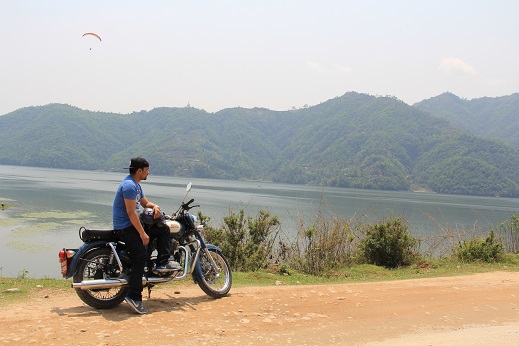
Blue colored Royal Enfield. 200 kms one way from Kathmandu to Pokhara. An adventure of a lifetime!!!
On the eve of the Nepali New Year 2074, I travelled with my brother, Amul Hamal Thakuri from Kathmandu to Pokhara on his Royal Enfield. The 200 kms distance took us past rice fields, small mountains, rivers, villages, towns and natural beauty only found on the base of the Himalayas. I had been to Pokhara before but not on a bike. Thus, the excitement to go on this bike ride was more for the journey than the destination.
It was Thursday morning. Around 9:15am. I’m doing my final checkup on the items to take for the trip. I meet Amul in front of his house, check that we have everything we need and take a selfie before embarking on our trip. Amul’s mother wishes us a safe journey from the rooftop. We are on our way. After getting the bike checked at the Enfield workshop at Balaju, we leave the capital a little after noon. Kathmandu is currently busy with a lot of vehicles and dusty from road construction and pollution and I say to myself “it would be great to get some fresh air and come back to Kathmandu refreshed.”
The roads leading up to Thankot, the exit point of Kathmandu are not that smooth. Thus, I felt like I was going to get thrown off the bike a few times. With Amul driving and a backpack between us, I was at the edge of my seat and felt the discomfort in my lower back. Occasionally, I kept moving back and forth from my seat to ease the situation. As soon as we passed Thankot (video above), we were going downhill and it was more easier for me. On our way down, we drove past a forest fire that was being taken care by the firefighters. There was a lot of traffic-mostly from people leaving the capital for the New Year weekend. There was no way of reaching Pokhara before dusk on a car or bus with this kind of traffic and I was thankful that we were on a bike. We were able to maneuver through the gridlock caused by road construction and move faster. At one time, we trailed an ambulance which was given room to move ahead. After two hours on the bike, I suggested Amul to take a break and stop for lunch.
Our lunch-a platter of rice, vegetables, carrot and chicken curry was the perfect meal for us. I could not have been more satisfied and decided to go for a second serving of rice and curry. Our lunch meal comes out to less than 800 rupees (about $8). With our stomach filled, we head back on the road and the journey continues. Along the road, we stop to pay the road toll which is only 5 rupees for a two wheeler. We continue on our adventure and drive past Enfield riders who were participating on the Enfield Poker Run. Amul had wanted to participate in the Enfield Poker Run for a few years now and he was ecstatic to see the riders on the road. We stopped by a restaurant along the highway where hundreds of riders had convened and took pictures with them. It almost felt like we were on the poker run with them. Seated in the back, I took videos along the way and my phone was almost out of space by the time we reached Pokhara. As we go past bridges, curves, hills and valleys, we see a big sign welcoming us to Pokhara. It’s closer to 6pm and it took us over 5 hours to reach Pokhara from Kathmandu.
A few of my friends from Kathmandu to whom I had shared that I was going to Pokhara for the New Year weekend did not think Pokhara would be so busy as it is for the English New Year. I was surprised and far more delighted to see the throngs of people on the street as we made our way into lakeside. Pokhara was buzzing. Literally. We waited for Amul’s friend, Nitesh Shrestha at the parking spot to take us to the hotel. We reach Traveller’s Guest House and freshen up quickly before heading out to enjoy the evening. Nitesh recommends us to go to Trance, a restaurant cum lounge for dinner and to enjoy the New Year’s eve atmosphere. As we walk past the festive crowd on lakeside, I see hundreds of people reveling in the eve atmosphere. We order sphagetti and pizza at Trance. People are dancing outside on the grass and others are joining them. Amul and I decide to head back to the hotel to recharge our phone before stepping outside for the New Year’s Eve scene. At lakeside, I run into my coworkers, Sunita and Anjali who were also in Pokhara returning from their Mustang trek. We were both surprised to meet each other and decide to grab lunch the next day. We tried to enter Busy Bee, a popular restaurant/live music place which is packed tonight for New Year’s Eve party. Amul and I wish each other Happy New Year 2074 as we walk around lakeside and revel in the New Year atmosphere. This was my first time spending New Year’s Eve in Pokhara and it was a memorable one.
New Year Day 2074. We get up around 9am to the views of mountains and the Phewa lake. We walk past many restaurants and decide to have breakfast at Mike’s Restaurant, located on the edge overlooking Phewa Lake. This is a great view and we order Mike’s breakfast platter and start to make plans for the day. My coworkers whom I met last night text me saying that we will be meeting at Roadhouse Cafe for lunch. As I sit at Mike’s Restaurant, I reflect on the flexibility and peace of mind of not having planned too many things for this trip. I can actually relax and enjoy each moment without having to rush. After finishing breakfast, we walk around lakeside and see many tourists visiting shops and eating out at restaurants. Pokhara for me seeks like a very laid back version of Thamel. At Roadhouse Cafe, we surprise two other coworkers, Sushan and Sujan who had arrived Pokhara few hours ago on a scooter. We share with them the experience of riding on a Enfield to Pokhara and decide to later meet at Busy Bee. For lunch, we head to Pokhara Thakali Kitchen, a place that Amul was very impressed with the last time he was in town. Pokhara Thakali Kitchen is packed with tourists and locals alike. We get a platter of rice, lentil, cauliflower, chicken curry and papad. After lunch, we stroll the streets of lakeside and take pictures overlooking Phewa lake. The weather looked like it was about to rain so we head back to the hotel and rest. Later in the evening, we head to Nitesh’s home for dinner. His parents were gracious to host us for dinner and we had a variety of delicious food. We then make our way to Busy Bee.
There is light rain tonight in Pokhara. I’m thinking Busy Bee will be averagely packed but am surprised to see the place just buzzing. My coworkers from lunch are already at Busy Bee finishing their dinner. There is live music playing on the right side of the restaurant’s entrance. We head over there and enjoy the live music with Nepalese rock stars-their hairstyles reminding me of Axl Rose from Guns N’ Roses. After enjoying a few hours of live music, we danced our way into the night with the club music playing. People from different races and ages are all dancing in their own tunes in the dance floor. It was a night like no other and we thoroughly enjoyed it. We returned to our hotel and slept like we had just conquered the night life of Pokhara.
Mornings are such a beautiful treat in lakeside-the views of the mountains, clean air and almost no noise pollution makes any traveller extend their stay. Our friends in Kathmandu had recommended us to visit Dunga Restro and Lounge Bar on lakeside which was supposedly the new restaurant to check out in Pokhara. We make our way to Dunga (meaning boat in Nepali) for breakfast. The stairway leading to the restaurant situated on the 1st floor gives a pleasant view of the lakeside streets on one side and the view of Phewa Lake/mountains on the other side. We order ourselves the Dunga Breakfast platter (about $4) and take pictures around the restaurant while waiting for our food. The Pokhara hospitality is on display as the restaurant staff politely ask where we are coming from and provide us information on the bands that played on New Years Eve at the restaurant. Our breakfast platter is here and we devour it. We rave about each item on the platter – toast, sausage, eggs, potatoes and coffee. We head back to the hotel, pack and pay for our stay (about $30 for two nights). Then we head to Pame, located on the outskirts of Pokhara’s lakeside. On our way to Pame, we notice many people paragliding and park our bike where the paragliders land. It’s almost like a beautiful dance to see the paragliders move in the sky and land effortlessly on the grassy land at Pame. As we spend close to an hour at Pame, we see between 25-30 landings and each photograph turns out to be an amazing postcard representing Pokhara.
Hoping to reach Kathmandu right before nighttime, we head back to the hotel, pick up our backpacks and leave for Kathmandu. We drop off a backpack at Nitesh’s premise and thus the ride back home is more comfortable. We fill the petrol, get the tires checked and head to Begnas Lake, another popular freshwater lake which is located 10km southeast of Pokhara. Begnas Lake was filled with many locals and a handful of foreigners. Many locals were getting ready to get on the boat while others were walking around the lake. After strolling the elevated pitch around the lake, we get back on the bike and on the road again. We stop at Mugling, a well known junction for travellers commuting between the three major cities-Kathmandu, Pokhara and Chitwan. We had a late lunch of buff momos and chowmein-both tasty and filling. After few more hours on the bike, we reach Kathmandu a little after 8pm and the journey of a lifetime comes full circle. I’m tired, hungry and exhausted by now. However, I will forever cherish the experiences, memories and adventures from this Royal Enfield trip from Kathmandu to Pokhara and back. Happy New Year 2074.
Things I realized or discovered from this trip:
Most of us go on trips with an itinerary on hand and want to check off all the things or as many things as possible on the list. Yes, there are times to do that but once in a while you should go on a trip without planning too much. I was sipping the coffee at breakfast besides Phewa lake and enjoying every sip without feeling the rush to move on to the next activity. The whole trip felt like that breakfast moment.
Life is a journey not a destination. The adventure and excitement of going to Pokhara and coming back to Kathmandu on the Royal Enfield was definitely the highlight of the trip.
Go with your intuition and the rest will follow. Going on this trip just felt right from the beginning and we were very lucky to receive many help from people along the journey (friends, locals and strangers).
Leaders build culture. In any organization or group, the leader sets the tone or creates its culture. It’s up to you to decide what direction the organization should take.
As a leader, I believe its important for them to set the culture (guidelines, best practices and values) of the organization. The leader should set the right values of the company and share it with everyone. Values will become the guiding compass when the team members have to make decisions (be it expected or unexpected). If the organization’s values are not created or not shared with everyone, then the team member(s) will make decisions on what they see fit (which may or may not be what the organization would see fit). Thus, create simple values, share it and evolve with it.
It was still wee hours of Friday, March 10. Having woken up at 4:30am, I got ready quickly and was walking briskly towards the microbus and tempo station in Old Baneswore. I had to reach the bus station before 6am to meet my other friends. We were all very excited for this trip to Sailung and could not afford to miss the only bus to our destination.
A few days earlier, there were rumors of a strike. We did not know who was planning the strike or what their motive was. That morning there were no signs of a strike just yet. At the microbus and tempo station, there was a man with his family and a lot of luggage by the side. He approached me and said “There are talking about a strike today. Where are you going? Are you also heading to the bus stop?.” I said “Yes, I am heading to the bus stop.” As we’re talking, a blue microbus turns the corner and stops a few steps from us. I hurriedly get on that microbus not sure whether this is my only chance to reach the bus station. Although this is a 8 seater microbus, there are already more than 11 people inside. The tight space inside with commuters along with their backpacks almost gave me claustrophobia. I sat on the little space between an aged woman and a young commuter. Within 15 minutes, I reach the bus station and am glad to be the first of my friends to arrive. I call some friends and learn that they are on their way to the bus station. Some were on their bike while some were still at their homes. As I await at the bus station, I search for food to fill my empty stomach. There are fruit sellers with their bicycles and small snack vendors around the bus station. I scour the area and decide to buy grapes and water bottle. A friend arrives and now we’re awaiting for 11 others to join us at the bus station. As more of our friends arrive, we search for our bus to Sailung and get on it. All 13 of us are now on the bus, seated and awaiting its departure.
Our bus leaves the station. We leave the beautiful and dusty capital, Kathmandu for a few days. We are on the way to Sailung!!!
Patan Museum is an incredible place. A place that captures the history of a time in Nepal that was rich in architecture, culture and people. Always a delight to visit Patan Museum.
We like to talk without hearing what the other person is trying to say. Are you actually hearing them out or just verbally expressing only what’s on your mind? Does the person you’re having a conversation with feel comfortable sharing his or her thoughts? Yes, you have an opinion and response but do you actually let the other person finish speaking first?
Far too many times, I’ve realized that listening is 80% important and speaking is 20%. The outcome is better, results are better, the connection is better. All you have to do is prioritize the listening part.
Wow! What a difference does 15 MINUTES A DAY devoted to learning makes to your life. If you invest just 15 MINUTES A DAY to learning something new everyday, imagine how much you will learn by investing 30 minutes per day or an 1 hour a day and so on. My goal is to be a lifelong learner and to always seek knowledge and wisdom.
In early December 2016, I started experimenting with 15 MINUTES A DAY to focusing on learning a new concept, idea or subject matter. I picked a different topic each day: business of NBA, Superbowl history, video editing tutorial, Tools of Titans chapters, magazine articles etc. The breadth of knowledge gained on different subjects over this period has motivated me to continue this habit.
Some thoughts with experimenting on this habit: I tried to set aside 15 minutes at the same interval each day but it was easier said than done. So I did not restrict myself with a specific time of the day as long as I got the 15 minutes committed to learning. Choosing the topic of the day was really easy as I am curious about a lot of things. Picking the next subject matter to learn is always the exciting part of this experiment. The inspiration can come from anywhere-while travelling, watching TV or just taking a walk.
As Warren Buffet said in a Forbes interview: The best moat you can have is your own talent. How are you developing your talent, craft or passion? Are you investing in building your best moat? Are you learning everyday?
Does Tawa Food have the best chicken momos in Jackson Heights, Queens, New York City? I believe so.
Having lived close to Jackson Heights for many years, I have had the pleasure and joy to enjoy some of the best momos in New York City. You can’t find any other place concentrated with so many choices of himalayan cuisines than Jackson Heights. Thousands of immigrants from the South Asian region reside in Jackson Heights or around it and thus you have access to the flavors, tastes and culinary from that region.
To find the best momos in Jackson Heights, I have gone from one restaurant to another. There are many contenders for the most delicious momos (Lali Guras, Himalayan Yak, Woodside Cafe, Bhim’s Cafe) but for me, Tawa Food takes the trophy for now. Tawa’s chicken momos are juicy, tasty and have a flavorful bite to them. A plate of hot momos on a rainy evening in New York City is the perfect comfort for any foodie. There can be a wait time of 10-15 minutes for your momos to be prepared at Tawa but its worth it. And what better way to wrap up your momo cravings than some bites at Tawa Food and a masala tea at Kebab King.
When I first started reading TOOLS OF TITANS: THE TACTICS, ROUTINES, AND HABITS OF BILLIONAIRES, ICONS, AND WORLD-CLASS PERFORMERS, I combed through the chapters of people whose names I had heard before or recognized right away. Then I started to go through chapters of other icons.
After going through several chapters of the book, it is easy to notice that the icons have their own disciplined approach to their craft. Some eat the same thing each morning while others follow the same routine before getting into their zone. It is great to learn of simple habits of the uber successful individuals. What I am taking away from reading about these icons is that each person has to find what works for himself or herself. The book is a good guide to learn from the greats and take them as inspiration to find your own unique talent. Be the best version of yourself.
Have you read the book? What are your thoughts on it?
June
-Presented on the topic “Artificial Intelligence in Business” at ICT Meetup V4.0 at Prime College in Nepal.
October
-Panelist on the topic “Nepalese in Technology Entrepreneurship” at Malingo NY in US.
-Attended many sales and marketing meetups in New York City
Besides the speaking engagements, I also enjoyed traveling around Bangkok, Pattaya & Koh Larn in Thailand, continued to discover breathtaking places around Kathmandu, Nepal and fell in love with New York City all over again.
I am very thankful for the wonderful opportunities and personal growth in 2016 and very much look forward to 2017. Happy New Year 2017!!!
I was happy to share my experiences and insights on technology entrepreneurship in the Nepalese context at an event in New York City. Besides sharing my experiences as an Operations Manager at Fusemachines Nepal, I talked about the current technology entrepreneurship ecosystem and opportunities in technology companies in Nepal. Organized by Nepalese Young Professionals in New York (NYPNY), this forum featured various entrepreneurs sharing insights and experiences from starting and building their businesses. Speakers in this forum included Nabin Banskota, Niran Shrestha , Nitin Sharma and Pawan Tamang. Thanks to NYPNY for organizing this event.
More posts coming on how to build a tech company in Nepal.
I am currently reading Tools of Titans: The Tactics, Routines, and Habits of Billionaires, Icons, and World-Class Performers by Tim Ferriss.
I first heard about the book when I visited Tim’s blog a few months ago. On his blog, I read Arnold Schwarzenegger’s foreword for the book and it got me more interested to read the book. I also listened to Arnold’s interview on Tim’s podcast and had a little bit of idea of what to expect in the book.
My first impression of the book when I received it from Amazon was “Wow, this book looks like a dictionary.” When I held it in my hand, it was actually lighter than what I had thought. I quickly read the first few sections of the book and then jumped into sections of people whose name I recognized.
Coming soon: Review of Tools of Titans: The Tactics, Routines, and Habits of Billionaires, Icons, and World-Class Performers by Tim Ferriss.
We want to be part of something bigger than ourselves. Joining a meetup, attending a networking event or taking part in a conference are some of the ways to be involved in the community.
I’m always looking forward to learning something new. So I attended Your Best Sales War Stories & Holiday Party organized by Enterprise Sales Meetup on Tuesday, December 13, 2016 at BetterCloud premises. I was looking forward to hearing war stories from sales professionals. Mark Birch shared a story of a time when he and a team member went to pitch a prospective client. Although their pitch was great, the prospect did not sign and cited that the team member was wearing a Mickey Mouse watch as the reason for not signing up. It was very funny to hear that out of all the reasons.
An entrepreneur shared a story when he really wanted to meet Richard Branson who was visiting New York City for an event. He figured out exactly where Richard was going to be that particular day and prepped himself accordingly. When Richard was on stage waiting for a contestant, the entrepreneur rushed to the stage, quickly pitched his business idea and handed Richard a napkin with his name and phone number. Two weeks later, he was at Bryant Park and received a call from Richard Branson’s office. It was not a sales war story but I took it as a story of perseverance and connecting with the person you really want to.
I started an experiment. The experiment is to allocate 15 minutes each day to learn something new.
There is no shortage of resources to learn from in today’s world. Connect to the internet from any corner of the world and you enter an universe where you can learn anything and as much as you want. What you need to become more knowledgeable is curiosity, focus and dedication to continuous learning.
On the first day I started the 15 Minutes A Day experiment, I read How Tim Ferriss Became the ‘Oprah of Audio’—Behind the Podcast With 70M-Plus Downloads on the Observer website. The article was informative and a fun read. I am already excited on how much I will learn each day going forward. At the end of each day, I feel accomplished, informed and happy that I learned something new. A day well spent.