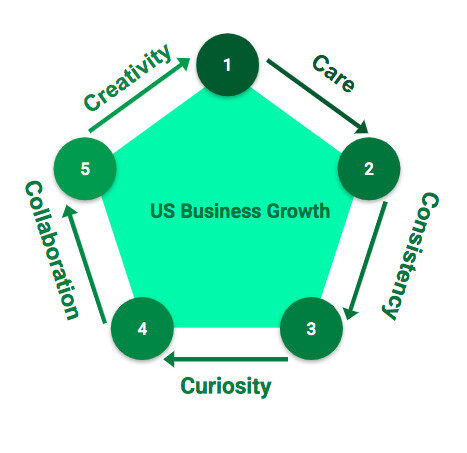
US Business Growth Using The 5C’s Framework


Managing clients successfully requires effective client excellence habits.
As James Clear, author of Atomic Habits, says:“Habits are the small decisions you make and actions you perform every day.” When it comes to client management, those small decisions build trust, drive outcomes, and create long-term partnerships.
Whether you have one client or many clients, the good habits will help you stay proactive, navigate challenges, and deliver consistent value. You need the mindset to improve, evolve, and care deeply about the work.
The 5 Habits of Client Excellence
In my experience managing clients, I’ve found that the best teams operate on five essential habits.
1. Care
Be prepared, be on time, follow through, and show empathy. Show your client you’re invested in their success.
2. Curiosity
Learn about their business, their industry, their goals. Ask better questions. Be genuinely interested and you’ll discover new ways to add value.
3. Creativity
Don’t just solve problems, solve them in new and better ways. Challenge assumptions, try new ideas, and bring bold thinking to the table.
4. Collaboration
Work alongside your clients, not just for them. Own your part, communicate openly, and aim to deliver what you promised and more.
5. Community
What you do for one client impacts your team, your company, and the broader community. Make it count.
Client excellence isn’t a destination, it’s a daily commitment. Start with the habits. Build the culture. Let the results follow.
Bill Gross started Idealab in 1996. Since then, Idealab has come up with more than 5,000 ideas, started more than 150 companies, and had more than 50 successful IPO’s and acquisitions including created more than 10,000 jobs and thousands of new entrepreneurs.
Bill shares 25 lessons learned from 25 years of starting companies.
Lesson 1: Challenge the Status Quo
Lesson 2: Find Great Timing
Lesson 3: Learn to Say No
Lesson 4: Be Success Sensitive
Lesson 5: Find Product-Market Fit
Lesson 6: Become a Great Story Teller
Lesson 7: Be Lean
Lesson 8: Be Remarkable
Lesson 9: Try Again
Lesson 10: Build A Complementary Team
Lesson 11: Be Persistent
Lesson 12: Protect Your IP
Lesson 13: Ignore Downturns
Lesson 14: Use Moore’s Law
Lesson 15: Iterate Like Crazy
Lesson 16: Be Frugal
Lesson 17: Find your Purpose
Lesson 18: Culture Eats Strategy
Lesson 19: Have Laser Focus
Lesson 20: Make Investors Money
Lesson 21: Be a Learning Machine
Lesson 22: Always Be Fundraising
Lesson 23: Be Transparent
Lesson 24: Ignore Sunk Costs
Lesson 25: Embrace Diversity
Few benchmarks to a better startup ecosystem:
Is it easier for an aspiring entrepreneur to start a venture now than 10 years ago?
Do the current entrepreneurs face the same challenges as the ones that started 10 years ago?
Who are the entrepreneurial success stories in the current business environment?
What are the main reasons entrepreneurs fail in the current business environment?
How diverse are the upcoming/current entrepreneurs and investors in the market?
Are there better resources (tools, entrepreneurial network/support, access to financing) now than 10 years ago?
What did you contribute today?
Did you contribute time, energy, thoughts, ideas, money, experience, or skills to something you believe in?
Why not contribute to other’s success as much as your own?
A thoughtful and meaningful contribution to a conversation at home, work, online, or something that resonates with you is a day well spent.
Having more time to deliver on a project or think of better ideas or finish a task does not necessarily lead to better results. Many times we can achieve quality output within a short amount of time, creative idea(s) can flow pretty quickly, and you can finish tasks much faster than needed or initially thought it would take to complete.
Setting a deadline to deliver on a project/task can be one of your productivity tools.
If there’s no deadline, you might spend time lingering around than really diving deep into the project/task, lose momentum, lack on motivation or desire or completely forget about it etc.
For our work quality to be excellent, we have to focus on more than the work itself.
To get the most out of your focused time at work or craft, we need to get plentiful rest, energy, and “intentional” time away from work. If you feel the most productive in the mornings, you should do your important and high priority work in the morning times. You can take care of the not as important or other priority tasks in the second half of the day. Likewise, if you feel the most productive in the evenings, you should do the important and high priority work in the evening times and do the not as important or other priority tasks in the first half of the day. You organize your day based on how you work best!
In addition, finding and doing recreational activities beyond our work enables us to be more energized and creative when we get back to the work again. Great creative ideas can sometimes come when you’re moved away from work or not thinking about work all the time. Natural sunlight, walks, music, arts, healthy food, meaningful relationships, and many more contribute to producing excellent work quality.
How do you bring about the best version of yourself everyday?
An important course that’s urgently required and needed in high schools and colleges is Lifelong Skills.
The Lifelong Skills course will cover why certain skills are important no matter what career a student chooses to pursue after their academic years, how to build productive habits for personal and professional growth, and why no matter what educational degree someone holds, gaining skills will be a lifelong journey. Skills will take students and professionals further in their career than talent alone!
Certain skills are valuable lifelong skills: communication, listening, writing, creative, team work, curiosity, authenticity, personal finance management, selling, teaching, coaching, learning, reading, adaptability to name some. If we become aware of these skills and sharpen them early in our professional journey, we will be better suited and authentically successful in the dynamic world that we live in. Technology will continue to become better, faster, cheaper and the more we hone our “human” skills, the better prepared we will be.
Besides the academic subjects we teach in high schools and colleges, it’s high time that we teach students Lifelong Skills and cover the basics to get them ready for the next chapter in their academic and professional careers.
Once upon a time on a weekday, people got up, got ready, and commuted to a physical work location.
That was the “normal” work routine in many places globally.
On Monday morning, individuals got ready, had breakfast at home/in their commute to work, worked for 8 hours, and then returned home. Same routine for 5 days a week. 2 day weekend and long weekends on certain holidays. Lots of time and money spent on commuting to and from work. How productive this “system/structure” has been is up for debate. Working from home was way less common than it is today.
These days, individuals get up, get ready, and work from their home work station all 5 days of the week or commute few times to their physical work location or still commute 5 days a week. A hybrid work model seems to be here to stay and both employees and employers benefit from this.
Leaders are made.
Leadership is a skill.
Individuals become better leaders by honing their leadership skills.
To hone leadership skills, take the lead wherever possible-community, company, family etc.
We all start from somewhere and become better with practice, smart work, learning, and reflecting.
Do startup founder(s) get more credit for the startup’s success or blame for its failure than other members of the startup (managers, technical leads etc)?
We know of founder(s) who started companies but what about the initial 5 to 50 employees who helped the startup grow.
What contributes to a startup’s success? Is it the founder(s)’ idea, their execution, their initial key hires, or just the timing of their idea(s)?
How much should we praise founder(s), recognize their successes and failures, and attribute to the startup’s growth?
Road trips are fun and adventurous with a good group, couple or on our own.
If we’re driving to a destination, we can choose some places to stop along the way that interests us : local eats, city attractions, must-see locations/landmarks and other interest(s) we have.
A good mix of planned activities/stops along the way and unplanned stops to see if certain locations/ landmarks seem exciting can make the journey memorable.
Few good music playlists, podcasts, and audio books can make the travel fun and entertaining.
Packing healthy snacks and drinks provides needed fuel and energy to our body!
Workshops that could provide tremendous value to current college students especially after they graduate are:
Financial Management
Priority Management
Skills Development
Health and Fitness
Leadership
Networking
One of my favorite parts from Kobe Bryant’s The Mamba Mentality How I Play book is the page with the heading I Asked A Ton Of Questions. In that page, Kobe shares:
I asked a ton of questions.
I was curious. I wanted to improve, learn, and fill my head with the history of the game. No matter who I was with—a coach, hall of famer, teammate—and no matter the situation—game, practice, vacation—I would fire away with question after question.
A lot of people appreciated my curiosity and passion. They appreciated that I wasn ’t just asking to ask, I was genuinely thirsty to hear their answers and glean new info. Some people, meanwhile, were less understanding and gracious. That was fine with me. My approach always was that I’d rather risk embarrassment now than be embarrassed later, when I’ve won zero titles.
Image by : Andrew D. Bernstein
Workshops are focused, interactive, and the results can be immediate.
With the current pace of technological advancements, workshops are more effective than year long programs to get faster and effective results.
The format of workshops enables participants to learn a new skill, become more knowledgeable about a topic/subject, interact with other team members etc. in a short time frame.
Online workshops can be as effective as in person workshops and can have participants from various parts of the world.
Which workshop(s) have you attended recently or planning to participate in?
Simplicity is the ultimate sophistication. – Leonardo da Vinci
Everything should be made as simple as possible, but not simpler. – Albert Einstein
Nothing is more simple than greatness; indeed, to be simple is to be great. – Ralph Waldo Emerson
The commonplace about Italian cooking is that it’s very simple; in practice, the simplicity needs to be learned, and the best way to learn it is to go to Italy and see it firsthand. – Bill Buford
To me, the extraordinary aspect of martial arts lies in its simplicity. The easy way is also the right way, and martial arts is nothing at all special; the closer to the true way of martial arts, the less wastage of expression there is. – Bruce Lee
How will the current and future of work look like? Is the hybrid work model here to stay?
Mark Ma, an associate professor of business administration for Pitt Business, and Yuye Ding, a Ph.D. student in Katz Graduate School of Business, looked at Standard and Poor’s 500 firms — the largest companies listed on U.S. stock exchanges — that had implemented return to work mandates, forcing employees to be in the office five days a week.
The results from the research study showed that while many of the companies said they were bringing employees back to the office to improve the bottom line, there were no significant changes in financial performance or firm values after the mandates were implemented. However, there was a sharp decrease in employees’ job satisfaction.
To keep employees’ happy and still maintain strong financial performance, companies should be more flexible and allow employees to work from home depending on their work nature, product/service, customers, industry etc. If productivity, work quality, and financial performance are not being negatively impacted by employees working from home, companies should allow employees work from home flexibility and provide support to them.
I love chicken wings!
Buffalo, NY has many restaurant and bar options to have the best chicken wings. There are favorite local chains as well as renowned food establishments. We recently visited The Nine-Eleven Tavern located in 9-11 Bloomfield Ave, Buffalo, NY. Established in 1981, the The Nine-Eleven Tavern is a Cash only establishment and opens on Tuesday through Saturday from 4:30pm-8:30pm.
In The Nine-Eleven Tavern’s menu, they offer Chicken wings – Wings are prepared mild, medium, or hot and include celery and bleu cheese or ranch dressing. For the sizes, you can choose 10, 20, 30 or 50 wings. They also offer Finn fries, Pizza Stix, Chicken Fingers, Corned Beef Sandwich and variety of extras. You can also buy a jar of their Wing sauce. I loved the chicken wings served on their special sauce. There’s only one sauce flavor you can pick and their wings are simply the best I’ve had so far!
From The Nine-Eleven Tavern, we can also takeaway some key business pointers.
Why offer too many sauce choices for the wings to customers when you can offer your best sauce and have customers come to enjoy what you serve best?
Why take credit cards if you can only take cash and avoid credit card transaction fees, credit card machines, and other credit cards related hassles that can come up?
Why open the tavern for long hours everyday if you can offer a window for customers to come and enjoy the wings?
How about sharing your biggest and limitless vision for your idea/company with your team and prospective employees?
One of the single most important reasons for top talented individuals to join a startup, growing company or even a multinational is the vision of the company’s founders or the company’s management/leadership team.
People switch jobs and careers all the time. Besides financial compensation package, benefits, perks etc., the most talented individuals are also looking to work on the biggest challenges, make tangible impact, and leave their own mark along the way. Next time you want to attract the best talent from the job market, share your idea and vision with them. See how that turns out!