Dwayne Wade wrote on Twitter: Every Basketball fan in the world should feel good for DRose. Tonite was an example of never giving up on yourself and when others believe in you. Amazing things can happen. I’m smiling like i scored 50! Congrts to a good dude!
Dwayne was congratulating Derrick Rose for his game on Wednesday night, scoring a career-high 50 points to lead the Minnesota Timberwolves to a three-point win over the Utah Jazz. The NBA brotherhood went on social media to congratulate Derrick on the special night especially given the physical challenges that he has gone through the past couple of years.
An inspiring story of a human being who believed in himself, kept going, struggled, kept on going and had a night that the world remembers. Thanks Derrick.
It’s easy to look at problems and say there’s no opportunity there. It’s easy to give up when faced with challenges. Yet if you are aspiring to become an entrepreneur or are an entrepreneur right now, problems and challenges are what you thrive in. Problems and challenges test you, your idea/passion, how much grit you have among many other things.
Here’s Dibyesh Giri sharing his entrepreneurial journey of building Smart Tech Solution in Nepal. Interesting to hear how he embraced problems/challenges, kept going and created opportunities!
The first book from the basketball superstar Kobe Bryant―a lavish, deep dive inside the mind of one of the most revered athletes of all time. In the wake of his retirement from professional basketball, Kobe “The Black Mamba” Bryant has decided to share his vast knowledge and understanding of the game to take readers on an unprecedented journey to the core of the legendary “Mamba mentality……”
Looking forward to reading this book to get insight, knowledge and wisdom on how to be excellent at a particular craft.
The podcast was beautifully narrated by Father Ludwig Francis Stiller who was a dedicated historian and scholar of Nepali history. I needed to know the history and am so glad to have found this podcast. I had been to Chandragiri Hills twice and remember the Prithvi Narayan Shah’s statue there. I had brief knowledge of Prithvi Narayan Shah’s conquest of Kathmandu before and the podcast really helped to understand the events, people and dates among other things.
How do we make Kathmandu a smart city? How do we manage the growing traffic congestions, air quality, complex address systems among many things in the capital and then eventually in all cities of Nepal?
Here’s a quick look into how the city of Palo Alto is using technology to address its urban needs.
If Pema wants to write for the national newspaper, he needs to come up with a good story, content and the right length (over 1200 words). Just pondering on the possible topic and how much he will get paid once the article gets published won’t be of much help now. Pema needs to take certain steps. He can open his laptop and start writing a possible topic or what he knows. The publication ready article might take some time but the small step of opening the laptop or notebook and writing a few lines will help Pema tremendously.
The vision and goal of any project/task will allow an individual or team to keep the big picture in mind. However, it’s the small critical steps in the beginning of the journey that is vital to accomplishing the goal. It would seem overwhelming to try to achieve something big without having the consistent daily or weekly targets/milestones leading up to it. Breaking the big goal down into small achievable tasks will boost the team’s confidence, build momentum and lead to a more satisfying result.
When does a company need to integrate a social purpose to their existence? As soon as the company is formed? When there are 40-50 full time employees? How about 100-200 or 500+ employees?
It’s a question to definitely ponder upon for the company’s founder(s), board or management team/employees. John Wood states in his book, Purpose, Incorporated: Turning Cause Into Your Competitive Advantage that “business leaders saw purpose not as a nice thing to do but as a must-do-a key competitive advantage that could enhance enterprise value.” A company which is profit centered and also has a bigger social purpose will not only attract the best talent but can keep them engaged and happy. When you know the company you are working for is growing and also making a impact in the community, nation and globally then it definitely makes you feel proud.
From my point of view if you are about to launch your venture, think about integrating some social mission into your company’s mission/vision. Even a small team of 3-6 people can make a difference in the community. The social activities can include volunteering at an orphanage, elderly home, pet shelter, donating blood or giving time to any cause that you/team feel is right. There is no dearth of places that need your valuable time. If the company you work for is 100+, then you can mobilize a small team to take up social activities on the weekends or holidays. There is so much that can be done and the volunteering ideas can be endless when you’re ready to contribute.
Having also a social purpose to your company will attract talent, keep the talent engaged and make them proud to be making an impact. Wouldn’t the world be a better place when all of us contribute whatever we can to something bigger than ourselves?
There’s no “right” time to start a business. It’s never too early or too late to start one. I believe what’s most important to consider is timing of launching the business.
When you’re working full time, you get to understand the challenges, problems and opportunities of working in a particular field/industry. Using that domain knowledge and skills you have acquired, you can work to build something on your own. Instead of quitting the job right away and working tirelessly on your venture, taking some calculated approaches can pay off big later on and minimize the time/cost/pain of launching a business.
Launching a business is very exciting and it completely changes your life. Taking the initiative to start an enterprise is daunting, challenging and thrilling at the same time. Here are few tips based on my experience and from others I’ve learned from on how to start your venture while still working full time.
In the beginning all you have is an idea. So do the research, collect data, talk to people/stakeholders, figure out how big is the problem you are solving, understand why no one has started the business you are about to or how many players are currently in the market. At this stage, your full time job will help you financially to start the ground work.
Once you’ve identified the problem you’re trying to solve for others, think of the name of the company and get the domain name/social media handles and channels in that name. Once I was at a Startup Weekend Kathmandu event and the winner’s web domain was taken by a competitor as soon as they were announced the winners. At this stage, you don’t need to leave your job yet because the above things can be easily done in a few hours.
Start putting up content and slowly work to build up your audience. You can tweet/post/write through the company handle so it won’t be noticed by your current employer. No need to mention that you’re the founder of the company yet. At this stage, your full time gig will be paying the bills that come along of initially setting up the business – domain/hosting/lawyer fees/company registration fees etc.
If you’re going to be selling a service or a product, build it yourself or hire people to make a MVP. You should not quit a job without getting your idea first tested in the market.
Once your product or service gets a bit of a traction, work to get paying customers and a steady revenue stream. Identify a business model that works and how you can scale it up. When the idea has gone from conception to execution and a product/service is out in the market, you will start to realize that the moment has come to devote full time on it. You will then have to approach your boss and explain to him/her why you will be moving on. Always important to maintain good relationship with your boss because they can offer your mentorship, support and help as needed. Then quit your job and devote 200% in your startup. It’s now or never. Nothing great has ever been achieved without taking some risks.
Starting a business is both extremely exciting and challenging. There’s no formula to predict the right time to launch a business. The timing of the idea is a crucial component of how successful the startup can be in the present/future. By taking calculated steps to launch the business as mentioned above, you will be in much better shape when you actually do.
As an entrepreneur, how did you decide it was the right time to launch the business? Do share.
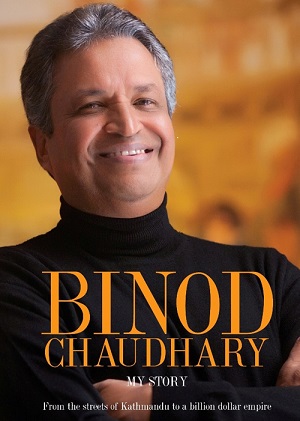
Binod Chaudhary’s autobiography English version. Photo: nepa~laya
Binod Chaudhary My Story From the Streets of Kathmandu to a billion dollar empire is a story of one man’s ambition, determination and vision.
Binod Chaudhary’s autobiography provides insights into his childhood, business ventures and plans to extend the Chaudhary Group (CG) brand globally. The entrepreneur provides historical context to how his grandfather moved to Nepal from Rajasthan when he was 20 years old. Early business experiences of the author’s grandfather setting shop (Juddha Sadak) in 1934 to his business prowess is shared in the beginning chapters. I loved the anecdote of grandfather opening his shop early in the morning to casually interact with the locals and building relationships. It was a smart exercise in public relations. After grandfather’s passing, Binod’s father Lunkaran Das Chaudhary worked to expand the business delving into exporting jute, construction and flooring and furnishing store. Arun Emporium was the most successful venture out of those.
The author talks about growing up in Kathmandu, his early interests in music and cinema and how he got into managing the family business. I was keen to learn about the origins of Wai-Wai, the popular noodle brand. Until I read the book, I had associated most of the entrepreneur’s success because of Wai-Wai but Wai-Wai is only one of the businesses of the Chaudhary empire. The author touches on his encounters with politics, FNCCI, CNI and relationship with the then royal palace. He also highlights his relationship with many world leaders. In particular, the story of Jeet Bahadur whom Narendra Modi treated like a son is shared. Jeet Bahadur’s story gained national headlines in 2014 and it’s good to know that he was reunited with his family. There is a chapter on the author’s guru, Sri Sri Ravi Shankar and how he become an ardent follower of him.
The professional battle stories of Binod Chaudhary showcase the entrepreneur’s business prowess, strong resolve and sheer will to get things done. Stories of Nabil Bank, Butwal Power Company and Mahalaxmi Sugar Mills are shared. A chapter on the start of a MNC highlights the foundation of a multinational company in Singapore with seasoned foreign entrepreneurs. Binod elaborates on a provision pertaining to Non resident Nepalis (NRN) in the Income Act which is worth mentioning. A Nepali who lived outside the country for more than 183 days a year was an NRN in the eyes of the law and thus he or she was free to invest abroad. Binod’s sons Rahul and Varun look after the business interests outside Nepal as NRNs. The later chapters go into the multinational journey of CG from the partnership with Taj, CG Hotels & Resorts (200 hotels by 2020) and the creation of CG’s first global hotel brand – Zinc.
I also liked the Business Mantras section where Binod dives deeper into the qualities and skills that an entrepreneur should possess such as high ambition, building organization, market astuteness, discipline, and negotiation skills among others. Besides sharing his achievements and accolades, he also reflects on the business opportunities he missed and regrets making a few bad business decisions. Self-evaluation section provides an introspective assessment of the author himself and is commendable.
For aspiring and current entrepreneurs in Nepal, the author’s insights and experiences with the Nepalese government, political parties, local competition among other activities present the reality of doing business in Nepal. Despite the abundant challenges that most of us know that exists in Nepal, Binod Chaudhary and the Chaudhary Group’s success domestically and internationally is inspirational in summary.
The author presents challenges for Nepalese entrepreneurs to invest abroad and how he had to find ways to do business outside of Nepal. There are plenty of examples shared of investment friendly countries and their leaders who welcomed Binod to open factories, hotels and plants in their regions. Much can be learned from Binod’s business experiences for the Nepalese government. Some areas where the Nepalese government and relevant ministries can help the country are 1) make legislation better/easier for Nepalese entrepreneurs to invest abroad 2) create an investment friendly climate in the country and remove government redtape 3) have a strategic vision for the country.
Binod Chaudhary’s autobiography is a very good read for someone to understand how the entrepreneur built a billion dollar empire. A must read for the youth of the country and for aspiring/current entrepreneurs who want to build a multinational company from Nepal.
Binod Chaudhary My Story From the Streets of Kathmandu to a billion dollar empire is published by Nepalaya.
The lights are on. Cameras are pointed to the stage. The audience is eagerly waiting to hear the jokes. At the end of this Thursday night at Samay Restaurant and Bar, the audience would have laughed hysterically to the 10+ stand up comedians that take the stage. I can say that this is Comedy Circle’s time to shine.
Few months back, I had watched a few of Comedy Circle’s YouTube videos of young and dynamic stand up comedians and was hoping to watch it live someday. I was very glad that I decided to see it live on Thursday, August 9th. Kudos to the team behind this fresh and delightful platform and wishing Comedy Circle for more success in the coming days.
If you’re looking for something refreshing and cheerful on a Thursday night in Kathmandu, check out Comedy Circle.
I Can’t Make This Up: Life Lessons by Kevin Hart is on my Book Bucket List.
Upon hearing about the book on a radio interview with Kevin Hart, I quickly searched online to find out more about the memoir. I found an exclusive excerpt from the book on Variety and got more interested in it.
Here’s a few sentences from the excerpt:
The goal was to break the tension and get them laughing, but without trying too hard. I’d still work to embody the part. Even if the role wasn’t for me, I wanted them to see how prepared I was and what I was capable of. I’d mix it up and play the character in ways that weren’t right for the film, just to show them that I had different levels.
I’m keenly interested in reading about Kevin’s journey to Hollywood and standup success, his come up struggles and his positive outlook on life etc.
Nepal is a breeding ground for entrepreneurs. With the amount of problems that makes up the beautiful and vibrant capital Kathmandu, it makes for a perfect platform for aspiring entrepreneurs to find solutions. The existing problems and challenges have inspired the new generation of entrepreneurs who are not waiting for a government initiative. They are addressing them head on and building ventures in and outside the capital.
Rudra Pandey, an entrepreneur shared his simple insights and knowledge at a recent Udhyami 101: Basics of starting a business event at Nepal Tourism Board.
A short video of Rudra Pandey delivering his speech at the event:
Leadership has to evolve. To constantly take on newer challenges and lead the pack. To drive the culture forward.
People are looking for ways to make an impact in the world. They are searching for the next big thing to attach their name to. They want to contribute and they want to matter. At times, there are already many platforms to contribute but there are times when the platform is not there, yet. The leader should recognize the opportunity or the void and create the platform for the pack and take the bold steps to venture into the unknown.
Leaders make decisions and focus on the next right thing. What is the next right thing in your position? What steps should you be taking right now? Are people counting on you?
Kathmandu has hosted a lot of startups and entrepreneurship related events in recent years.
The most recent one is Udhyami101 : Basics of Starting a Business which I attended on June 30th at Nepal Tourism Board. Although the event started about 20 minutes late, it went smoothly afterwards. The event began with Kavi Raj Joshi, STARTUPSNepal welcoming the speakers and audience members, reflecting upon the journey of his organization and purpose of Udhyami101. The program proved its worth right away when Dr. Rudra Pandey, Deerwalk (Rudra dai as he likes to be called) delivered the opening keynote speech Fundamentals of being an Entrepreneur. There was so much knowledge and insights shared within the 30 minutes or so that he took the stage. The audience was left mesmerized by his simple entrepreneurial insights and plain humor.
After Rudra dai’s speech, Srijana Shakya Jyoti from Honda Nepal talked about Jyoti Group’s investment arm. Following her speech, there was a panel Basics of Starting a Business featuring Bina Shrestha, Shine Nepal, Asgar Ali, e-Sewa, Sunayna Tamrakar, One to Watch, Anil Keshary Shah, Mega Bank and moderated by Rupesh Krishna Shrestha, Idea Studio Nepal. Narottam Aryal, King’s College talked about the importance of startup ecosystem, Baburam Poudel, Nepal Telecom talked about ICT for Startups and two Udhyami Seed Camp participants shared their experiences.
I took away several insights shared by various speakers throughout the evening. Entrepreneurs have to solve a problem. They should first identify a problem and build products/services accordingly. They know when to quit when things are not going well because they are the first ones to sense the business is not going well, the product gets bad reviews etc. It’s important to understand the market size of the product or service you are trying to build. Investment model in Nepal needs revision. The person/company working on the idea for years should have majority share rather than the investment company to provide incentive to founders/management team. They should have a social purpose to their business as well.
We first met in late January
Bright sunny day, blue skies hovering the clean city
Temples and shrines on each corner
Like a living museum
Growing up on the cusp of the Himalayas
I always aimed higher than the sky
You pushed me to fly and kept me down to earth
Gave me a higher purpose since birth
Took your love and care to places I traveled
You held my arms as I faced life
You gave me choices to become better
Opportunities to grow and be a leader
Everytime I came back, you looked a bit different
The identity was the same however I saw you in a new light
Proudly say your name whenever someone wants to know my roots
The kid from Nepal strutting my boots
Years later, I realize how much you had shaped what I stand for
You gave me that smile that many have complemented for
You’re beautiful even though the dust sometimes gets in your face
Life happening at a serene pace
More of the world is getting to know of your beauty and charisma
Which I had already known decades back
Stay as beautiful as you are
I’ll always remember you no matter where I am.
Recently, I have become keen on studying the science and art of focus and concentration. We all know that to become great at a skill or activity, focus is one of the key elements. I had previously written about Focus as well.
In his Ted Talk titled Unwavering Focus, the speakerDandapani does a solid presentation on our current habit of practicing distraction, the art of concentrating and understanding the mind. He states that “It’s in my humble opinion that most people can’t concentrate today, for two reasons. One is, we are never taught how to concentrate; and second is, we don’t practice concentration. He further adds So, how can you do something if you’re never taught how to do it? and How can you be good at something, if you don’t practice it? Those are profound questions. I recommend you watch his 17 minute Ted Talk.
In another Ted Talk by Dr. Cal Newport titled Quit social media, the speaker presents insightful and profound thoughts and experiences on social media. He argues that social media tools are designed to be addictive. The actual designed desired-use case of these tools is that you fragment your attention as much as possible throughout your waking hours that’s how these tools are designed to use. We have a growing amount of research which tells us that if you spend large portions of your day in a state of fragmented attention – large portions of your day, breaking up your attention….that this can permanently reduce your capacity for concentration. In other words, you could permanently reduce your capacity to do exactly the type of deep effort that we’re finding to be more and more necessary in an increasingly competitive economy.
I believe social media by itself is not all bad but you need to manage your time and attention properly. There are things you can do to do great work and still have a “social presence” on the web. Some ways are to allocate certain parts of the day or week to be on social media, to be away from social media when on vacation (it’s hard not to post a selfie on a trip to Italy but you should stay away from Instagram) and to be on only social media sites that you feel is critical to your professional success (LinkedIn rather than Facebook).
Do you remember a time when someone believed in you so much that you were almost fearless in participating in an activity?
Coming from someone whom you respect and trust, that belief can do wonders. Every time I got trusted to do a project or take on a challenge, I got that extra motivation to deliver and not disappoint. The fact that someone trusts you to take on a project or work is a feat in itself. Leaders know that words and behavior have to go hand in hand to motivate and inspire the team. Do you trust your teammates when the game is on the line or would you rather take that shot yourself?
It’s only right that as a leader, you should use your judgement to inspire your team and believe in them to do what is needed. Be ready to be amazed when you have done that.
The internet has democratized access and information. Do you feel like you are missing out on that Warren Buffet talk at Columbia Business School? Want to learn right from Mark Cuban about basketball and business? How about Seth Godin giving you tips on tribes, marketing and brands? No worries, the tools and tips are right there on the person’s website, YouTube or someone’s blog page. The content is there.
With ample resources at our fingertips, there is no shortage of information and access. Now the hard thing to do is keeping your focus. Focus on what matters. Focus on the little stuff. Focus on constantly learning and moving forward. To do great work, you have to focus intentionally and with intensity. Only then the results will exceed the expectations.
Dr. Cal Newport at TEDxTysons stated that “the market is going to reward the deep, concentrated work required to build real skills and to apply those skills to produce things -like a craftsman- that are rare and that are valuable.”In his most recent book Deep Work , he argues that focus is the new I.Q. in the knowledge economy, and that individuals who cultivate their ability to concentrate without distraction will thrive.
We met in early August
Summer coming to an end
Concrete buildings reaching the sky
A teenager with dreams up high
I got to know you better in high school
Off to college but we kept in touch
No matter how far I was
Distance made the heart grow fonder
I miss the hustle, grit and charm of the big city
Took the attitude and mentality always with me
Your tough love made me stronger
Kept me going through challenges and struggles
Always that city kid no matter what village or corner I went
Living proof that if I made it here that I could make it anywhere
Thanks for introducing me to people from all walks of life
Kept me humbly confident inside and not get carried away with hype
Thanks for raising me to be the person I am today
Your DNA is with me everyday
Thanks for making me dream big
It was all a dream, Big