Getting through the data noise

An authentic brand story will help your company get through the data noise.

How much data noise is really out there?

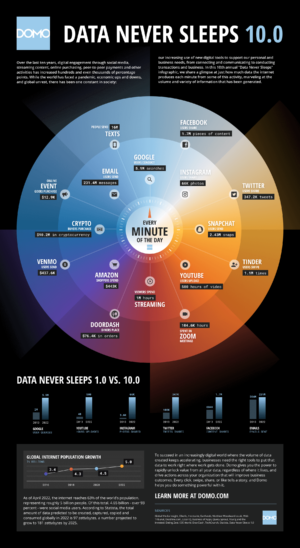
Domo’s Data Never Sleeps 10.0 presents some numbers.

Some notes from Domo:

Over the last ten years, digital engagement through social media, streaming content, online purchasing, peer-to-peer payments and other activities has increased hundreds and even thousands of percentage points.

As of April 2022, the internet reaches 63% of the world’s population, representing roughly 5 billion. 

According to Statista, the total amount of data predicted to be created, captured, copied and consumed globally in 2022 is 97 zettabytes, a number projected to grow to 181 zettabytes by 2025.

There will be more data generated in the coming days, months, and years. How will your startup or corporation get through the data noise? Will your company keep spending more money on ads, social media marketing , PR and others? Or will you invest in a long term strategy such as identifying your authentic brand story and leveraging it?

Is success really “self-made”?

We often see the below headline in the media (blogs, magazines, articles etc.) to describe an individual or founders’ success.

They were self-made billionaires. They were self-made entrepreneurs.

Then the rest of the media coverage goes something like this…

Person A’s company is now worth a billion dollars. Having started in her garage four years ago, Person A has disrupted the industry and won every industry award.

Person B had a dream to change the industry and with another co-founder, they developed a MVP over a weekend. Now their work has become an industry standard and they are pioneers in helping to move the industry forward.

Using the word “self-made” to describe individuals running successful organizations does not provide the full picture. We have fallen so much in love with the narrative of a solo entrepreneur or visionary who did it all. From having nothing at all to now running one of the biggest so and so company in the world. However, it’s rarely one individual who does everything and becomes successful. There is always a team who is helping to run the company and making sure everything is operating as smoothly as possible. That team could be a handful of individuals or a few hundred or thousand. Yet the credit or the media coverage usually goes to the founder(s) who took the risk, “sacrificed” almost everything, and made an impact.

Maybe it’s about time we find a different word to describe this type of success than calling them “self-made.”

What’s a word that celebrates the individual’s work plus highlights the contribution of the team?

the “perfect” work

Seth Godin’s blog today was Unbeatable vs Perfect. In it, he states that Google has killed more than 200 projects over the last few decades. They fail all the time. MORE THAN 200 PROJECTS!!!

Over the years, I knew Google discontinued a few products/services here and there but did not expect more than 200. Often we see a company, professional, or industry expert present an almost “flawless” or “perfect” product/service out in the world. We expect our work to be like theirs or close to it as possible. We forget that we are on our own journey to greatness. There is no need to compare, contrast, or feel deflated. What you can do from the work you see out there is to draw inspiration, motivation and keep going at your pace. There is “never” a perfect version of something and there is “always” room for improvement.

If Google waited for the “perfect” project/product/service to ship, we won’t be talking about them in 2022. They launched in 1998 and are still relevant to us more than ever before!

Also if I waited for the “perfect” blog to post, this post would be in my Drafts and you won’t be reading it at this moment. Thanks for reading my “not-so-perfect” blog.

Saved in my drafts

How many thought-provoking and authentic stories end up just in the drafts section of your blog?

How many original ideas stay in your employees’ head instead of being shared with the team and the company?

How many times does an important question gets missed because the individual feels like she or he won’t be heard or acknowledged for having the courage to share?

What holds people back from sharing and publishing their work? Are they waiting for the “perfect” moment to share the blog or idea or question? There’s no one size fits all answer to these questions. Pondering upon these questions is in itself an important exercise and a good starting point. I do this often when I compose a blog and then save it as a draft. On my blog, there are way more drafts saved than published. I save them so I can go back and add more content to the blog later, or the blog idea just came in my head and want to note it down or most times I tend to overanalyze on the blog’s quality and make a decision not to publish it yet. I am working towards publishing more blogs than just saving them as drafts.

Who’s the most valuable member of the company?

Since it was the founder/co-founders’ idea that led to the company’s start, is she/he/them the Most Valuable Member (MVM)?

Sales team brings in clients and revenue. Are they more valuable then?

How about the technology team that made the software which the sales team sold?

And the human resource team who found and hired the talent with the right attitude, education, and skillsets?

Let’s acknowledge the Training team who help employees to keep their skills and knowledge up to date as per company’s needs.

Getting the software in front of potential customers at the right place and time, isn’t the Marketing team deserving of applause and attention?

Client services team is communicating with the client and making sure they have an amazing experience. Don’t they receive credit on what they do to make the customers happy?

Rooting for Jonathan

Jonathan Livingston Seagull loved to fly, loved it so much that he went against its own flock to reach for the sky.

Yet we find fewer Jonathans soaring in the skies above because society wants conformity, has its beliefs and expectations. Many buddingJonathans face the harsh reality soon as they start going to school, around their neighborhood, and even at their homes. In lieu of protecting the ones whom we care about, we put our own insecurities and biases onto them and increase their self doubt and hold their independence. Rather than giving them freedom and choice to fly, we ground them onto the reality of the situation and make them have realistic expectations.

To groom the next Jonathan, realize first that each of us are unique and talented in our own ways. At times, its best to just let individuals to follow their intuition, learn from their experiences, and let them achieve their authentic greatness.

The creative narrative

“She is so creative.”

“He is really creative.”

“That’s the creative team.”

Creativity is hard to define. Each one of us is creative – that creativity can be seen at our homes, workplaces, the hobbies we have, the activities we do, and it can be anywhere and everywhere.

What type of environment helps in facilitating creativity could be a more interesting question to ask. In my experience, the initial moments of feedback given to an individual who is exploring her or his creativity is critical. In those initial moments, the words and behavior (feedback/response) absorbed by the individual will shape how he or she sees creativity and the world around them. These earlier experiences can form a narrative and a fixed or growth mindset can be set towards creativity which can have a profound effect in the individual’s ensuing years. Creativity is a muscle and it gets better through exercises and engagements.

All of us are creative in our own unique ways. Change the narrative, change the outcome!

Then what else do you see, Arjuna?

“What do you see?” I see the eye of the bird.

“Do you see the tree?” No.

“Do you see the branch?” No.

“Do you see the bird?” No.

“Then what else do you see, Arjuna?” Nothing, I see only the round black eye of the bird.

Excerpt from The Mahabharata – A conversation between Arjuna and Dronacharya

Your company’s “Chief Question-Asker”

“The most important thing business leaders must do today is to be the “chief question-asker” for their organization” says Dev Patnaik of Jump Associates.

Patnaik says that “the first thing most leaders need to realize is, they’re really bad at asking questions. The business executives rose up through the corporate ranks because “they were good at giving answers. But it means they’ve had little experience at formulating questions.” Without the company leadership setting the tone and culture to the rest of the organization that asking questions are important and critical to the business growth, it’s no surprise that the employees are not asking any or enough questions. If the employees who understand the company’s products/services are not asking any or enough questions to the customers/end users for feedback, or asking questions to explore new products/services in the market, the company will become stagnant and the competition will take over.

Adam Bryant, The New York Times Corner Office Column writer says that “the best leaders understand that asking open, exploratory questions can help them figure out what’s coming and where new opportunities lie, so that they can lead their company in new directions.” Leaders have to show vulnerability and humility to ask questions which is more important than upholding the persona of the leader who must “be all-knowing, decisive, and in possession of infallible gut instincts, all of which leaves little room for questioning.”

Are you the company’s “Chief Question-Asker”?

Quotes are from “A More Beautiful Question” by Warren Berger

Useful resources on curiosity and questions

Articles/blogs:

The DNA of the World’s Most Innovative Companies

Curiosity is a Must-have Skill

The Business Case for Curiosity

Forget Brainstorming. Try Questionstorming

Why must businesses step back in order to move forward?

Videos:

How to Ask Better Questions | Tim Ferriss

The Truth about Being the “Stupidest” in the Room | Simon Sinek

Podcasts:

Cal Fussman’s Big Questions podcast

The Career Contessa Podcast

The Tim Ferriss Show

Akimbo A Podcast from Seth Godin

Others:

The Right Question Institute

A More Beautiful Question

This list will be continuously updated. Please share any resources that can be added to this list.

Here’s a piece of advice…

Giving advice to someone is a tough ask. When someone reaches out to you for advice, you are put in a position of authority or power. It could be that the person seeking your advice thinks you are the right person, have the relevant experience, have information that others don’t or for any other reason. In essence, if someone asks for advice, he or she is looking for some sort of an answer from you. It’s a tall order to give accurate and meaningful “advice” to another person.

In his book, WILL, Will Smith says this about advice “The thing I’ve learned over the years about advice is that no one can accurately predict the future, but we all think we can. So advice at its best is one person’s limited perspective of the infinite possibilities before you. People’s advice is based on their fears, their experiences, their prejudices, and at the end of the day, their advice is just that: it’s theirs, not yours. When people give you advice, they’re basing it on what they would do, what they can perceive, on what they think you can do. But the bottom line is, while yes, it is true that we are all subject to a series of universal laws, patterns, tides, and currents – all of which are somewhat predictable – you are the first time you’ve ever happened. YOU and NOW are a unique occurence, of which you are the most reliable measure of all the possibilities.”

A powerful and practical way to approach this situation when someone reaches out to you for advice is to say “I am happy to share with you what has worked for me.” An example of this in real life is to watch this video of Dwayne Johnson “The Rock” speaking to the Los Angeles Lakers as part of their GeniusTalks series, reflecting on his career as an athlete and actor, and sharing lessons he learned along the way.

Books that inspire asking questions

Here are a few books that I found to inspire each of us to ask more questions. These books delve into the power of asking important questions, questions that can change the direction of a person, group, or company and provide insights into using questions as a helpful guide in our personal and professional lives.

Feedback for growth

Growing up in a household or being in an environment where you get mostly or only positive feedback, you will expect that type of feedback in all areas of your personal and professional life. How helpful is the (mostly or only) positive feedback for the person receiving it in the long run? Is that positive feedback motivating the person or setting up expectations/beliefs that are not really assisting her or him? If only positive feedback is being given by a coach to an athlete/by a parent to a child/by a manager to an employee, then it can be more counterproductive than productive.

Constructive feedback is better for us. We need to know where we are good at and where we need to improve. When we get feedback of our strengths and improvement areas, we can allocate our time, energy, and focus accordingly. If we become tempted to create a perfect world of positive feedback from coaches to athletes, parents to children, and managers to employees, we are being in the fixed mindset. It’s important to adopt a growth mindset which “leads to a desire to learn and therefore a tendency to embrace challenges, persist in the face of setbacks, see effort as the path to mastery, learn from criticism, find lessons and inspiration in the success of others. As a result, they reach ever-higher levels of achievement” (Carol S. Dweck’s Mindset: The New Psychology of Success)

How are you using the feedback you are getting?

Asking questions to understand better

Simon Sinek, author of Start With Why and other books says that “asking questions doesn’t mean you’re the stupidest person in the room; it usually means you’re the only one brave enough to speak up.”

Some of the reasons why we aren’t asking enough questions even when we don’t understand the topic of discussion are the beliefs/thoughts/internal questions we have going in our head:

By asking this question(s), will it make me look “stupid”?

Would I look like the person who doesn’t understand this topic if I ask this question?

It’s actually not relevant to me at all so why ask this question.

I am the “expert” or “smartest” person in this room. Why ask questions and make myself look like a beginner?

Do I have the “authority” to ask questions in this group or in this context?

the perspective

With new adventures, everyday challenges, feedback from others, conversations between employees and managers, and many other moments in our daily experiences, it’s important to keep them in perspective.

Imagine a scenario of a manager giving an employee honest feedback. It’s tempting for the employee to expect all positive feedback from his/her supervisor and vice versa. Yet do we really grow from just positive adulations? If the employee uses the honest feedback to gain awareness of their strengths/improvement areas and then gathers new skills and knowledge, it’s actually much better in the long term for both the employee and the supervisor. On the other hand, if the employee does not have the proper perspective on the manager’s honest feedback, then he/she can feel down, angry, or even hurt by their words or behavior. The same goes when parents are giving honest feedback to their children, coaches talking to their players/teams, teachers talking to their students etc. It’s all about the perspective.

In her book, Mindset: The New Psychology of Success, Carol S. Dweck says it’s tempting to create a world in which we’re perfect and we can choose partners, make friends, hire people who make us feel faultless. But think about it- do you want to never grow? Next time you’re tempted to surround yourself with worshippers, go to church. In the rest of your life, seek constructive criticism.

Grades or growth?

When we put a lot of focus on the grade in school and college, are we limiting the growth of the students’ learning?

If ultimately the course grade is what matters, then the students will study accordingly and stay within the framework of the course curriculum. In theory, the student’s grade is expected to represent his or her understanding of the course material and a way for teachers to assess the student’s knowledge of the subject matter. This will continue to keep many students incentivized to take classes where they can earn easy A’s and not be as hungry to seek out challenging yet important classes that actually lead to their intellectual growth.

As long as we have GPA’s and scores to measure progress and understanding of a subject matter, it will have its shortcomings. If it’s not going to be on the exam, then why would students put more extra effort than needed or go beyond their coursework. With GPAs and test scores not going anywhere anytime soon, we’re left to ask ourselves:

As a teacher,

how can you instill a hunger for learning beyond the course curriculum?

how can you prepare the students for a future of tomorrow?

how can you support the growth of students who are struggling academically but talented in other areas?

As a parent,

how can you encourage your child/children’s learning and education beyond the school’s course curriculum?

how can you encourage your child/children to ask questions as much as having answers?

how can you prepare your child/children for the future of tomorrow?

As a student,

why are you taking these courses and how will they add value to your long term career?

how can you become more aware of the changing job market and prepare yourself accordingly at school/college?

what are your strength areas and how will you continue to hone them or add more skills to be job market relevant?

Who sets the company culture?

The people who care.

The people who care think of an idea, an initiative and pursue an action. In a startup, people who care make or break the company culture. The values or ideals that the caring person or the caring group have will carryover and reflect in their initiatives and activities within the company.

Many employees want to be part of something bigger than themselves. When an employee cares about a topic or issue very deeply, they will take action and others with similar interests follow suit. But it always starts with the one who cares enough to do something about it. Great company cultures are rarely set by the majority of bystanders.

Great company cultures start and thrive on people who care about the topic or issue. If you want to build a great company culture, find the individuals who care and give them all the resources you can to let them implement ideas and initiatives and watch them grow. There will be challenges along the way but trusting the people who are leading the culture front and encouraging them would be the way to go to building a resilient company culture for the long term. The people who don’t care enough to do more than their roles and responsibilities will be there in each company. However, the company culture will be driven by the individuals who are passionate and voluntary lead the efforts.

Take care of your employees.

We’ve heard the phrase many times “Employees are a company’s greatest asset.”

Do you think most companies actually believe that phrase in their core and behave accordingly? That’s a profound statement that companies have to visit and revisit all the time. Some well established companies tout all the benefits they provide to their employees but seldom ask employees how they value each of the company’s benefits or what other benefits could be more important to them. Some companies’ benefits package reflects what their industry counterparts offer and do just enough to remain competitive employee benefits wise.

If companies wholeheartedly believe that employees are indeed a company’s greatest asset, how are they showing that they care for their employees?

Here’s something to ponder upon…

A better manager

In the beginning of anyone’s career, the company you choose to work for, your team, and the managers you have can shape your career trajectory. Your manager is a key facilitator to your professional growth. There is a lot of truth to the phrase that employees don’t leave companies, they leave bad managers. On the same note, some employees will stay longer at a company because of their manager, even though they can easily switch jobs, earn more somewhere else, or have a choice to do something else.

A better manager takes time to understand their team better, mentor them, challenge them, and expect the best from their team members. A better manager holds themselves to the highest standards and also expects the team to be at that same level. They appreciate their team members when they get results and coaches them where needed. Companies have managers because of their organizational structure, but becoming a better manager is their choice.

Are you choosing to become a better manager?

W.A.Y.T.O.G.O

“Our grandfathers and great grandfathers built schools to train people to have a lifetime of productive labor as part of the Industrialized economy. And it worked.” – Seth Godin

Schools and colleges worked their magic and most of the graduates eventually made their way to a beautiful five day work week of 9am-5pm. Seems like a smooth system to create and produce the labor force needed to work at corporations.

Now, we live in knowledge based societies with the need for people to be more creative and independent thinkers. Schools and colleges need to evolve with time and change their roles accordingly. With the advancements in technology such as Artificial Intelligence (AI) automating many manual tasks that workers used to do before and the speed of change we are witnessing like never before, our workplaces are not adapting as fast as it needs to.

The forty hour work week for all the employees might not produce the best results for the company. Employees should be working during the times they are most productive because some are best during the mornings, while others could be better working during the evenings or at night time. This is not to say that each employee should create their own work schedule or that managers will have an easier time managing their team members. Employers should focus more on offering the best flexibility to their employees and evaluate them based on the results that they bring. 

The Accenture Future of Work Study 2021 explored what people need to be healthy and productive as we enter a new era of work. Here are their main findings from the research report.

  • A majority of workers (83%) prefer a hybrid work model, but a variety of factors influence their ability to thrive, whether they’re onsite or off.
  • Responsible leaders must move beyond physical location to shape the future of work by giving people resources tailored to their needs.
  • 63% of high-growth companies have already adopted a “productivity anywhere” workforce model.

Work At Your Time Of Greatest Optimum (W.A.Y.T.O.G.O) is a new paradigm for work. At the start of each new hire, the manager and HR sit together and explain the team or department’s goals and the new hire’s responsibility. The new hire is required to produce the best work within a certain time frame. The focus is on the results. Flexibility is a privilege and the new hire should understand that it can be taken away if the results are not optimal or under par. If the new hire works in a team or needs face to face interaction, it can be a virtual video or audio call. In person meetings should be done if the team is fairly new so individuals can get to know each other or as absolutely needed. This can be more easier to implement in a new startup or even a small size team within established companies. This type of work model is necessary for productivity to thrive at the highest level.

 Which work model is your workplace currently following?